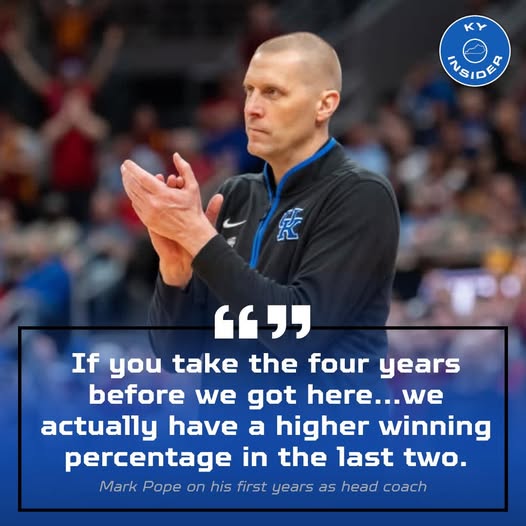
Mark Pope took a large portion of time on his final show of the season to compare the last seasons of the John Calipari era to his first two with Kentucky.
On his final show of the season, Mark Pope devoted a significant portion of time to reflecting on the state of the Kentucky Wildcats men’s basketball program, drawing thoughtful comparisons between the closing seasons of the John Calipari era and his own first two years at the helm. Rather than framing the discussion as criticism, Pope approached it as an honest evaluation of where the program has been and where it is headed, offering insight into the challenges and opportunities that come with leading one of college basketball’s most storied teams.
Pope acknowledged the immense legacy that Calipari built during his tenure. Under Calipari, Kentucky consistently attracted elite talent, competed at the highest level, and remained a national powerhouse for much of his run. However, Pope also pointed out that the later seasons of that era came with increased scrutiny, as expectations remained sky-high while results became more inconsistent. He emphasized that such fluctuations are not uncommon in college basketball, especially in a program where success is measured in championships.
In comparing those final seasons to his own early tenure, Pope highlighted the differences in approach and philosophy. He spoke about the importance of building a cohesive system that emphasizes player development, team chemistry, and adaptability. While recruiting top-tier talent remains essential, Pope stressed that creating a unified identity on the court is equally critical. His comments suggested a deliberate effort to balance talent acquisition with a structured style of play that allows players to thrive collectively.
Another key point in Pope’s reflection was the evolution of the game itself. College basketball has changed significantly in recent years, with factors such as the transfer portal and NIL opportunities reshaping how teams are built. Pope noted that navigating this new landscape requires flexibility and a willingness to adapt. In contrast to the earlier years of Calipari’s tenure, when one-and-done prospects often formed the backbone of Kentucky’s success, today’s environment demands a more nuanced approach to roster construction.
Pope also addressed the expectations that come with coaching at Kentucky, acknowledging that comparisons to previous eras are inevitable. He expressed respect for what Calipari accomplished while making it clear that his focus is on forging his own path. For Pope, the goal is not to replicate the past but to build a program that reflects his vision and meets the demands of the current era.
Throughout the discussion, there was a consistent theme of accountability. Pope did not shy away from evaluating his own performance, recognizing that his first two seasons have included both progress and areas for improvement. He emphasized that growth is an ongoing process, both for the team and for himself as a coach. This willingness to reflect openly is something he believes will ultimately strengthen the program.
The conversation also touched on the importance of culture. Pope spoke about fostering an environment where players are committed to one another and to the program’s goals. He believes that a strong culture can serve as the foundation for sustained success, particularly in a competitive landscape where talent alone is not enough.
As he concluded his remarks, Pope’s message was one of optimism. While acknowledging the challenges that come with leading Kentucky basketball, he expressed confidence in the direction of the program. By learning from the past and adapting to the present, he believes the Wildcats are positioned to build a future that lives up to their rich tradition.
In the end, Pope’s reflections offered a balanced perspective—one that respects the legacy of the Calipari era while outlining a clear vision for what comes next.