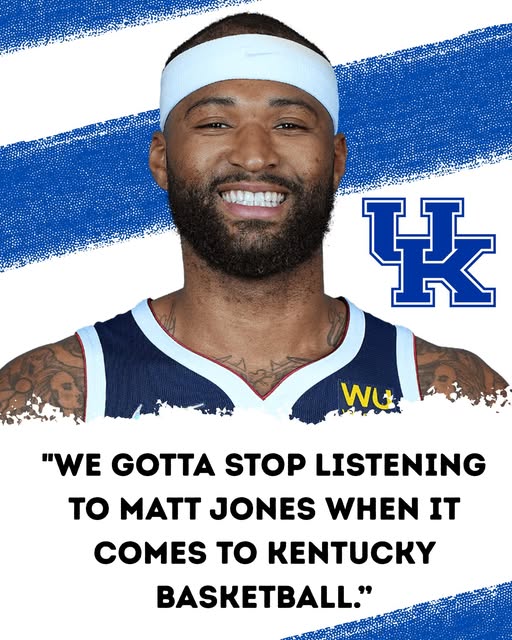
“DeMarcus Cousins Calls Out Matt Jones Over Kentucky Sports Radio Criticism as Kentucky Wildcats men’s basketball Debate Ignites Across Big Blue Nation”
The conversation around Kentucky basketball took a sharp turn when DeMarcus Cousins publicly voiced his frustration with the role media voices play in shaping the narrative around the program. Known for his unfiltered honesty, Cousins didn’t hold back, suggesting that too much weight is often given to commentary from outlets like Kentucky Sports Radio. His remarks struck a chord almost immediately, tapping into a long-standing tension between passionate fanbases, influential media platforms, and former players who have lived the reality behind the headlines.
Cousins’ central point was clear: during challenging stretches, external criticism can become more harmful than helpful. In his view, constant scrutiny and amplified negativity risk creating an environment that weighs heavily on players and staff, particularly in a program as visible and emotionally charged as Kentucky. For a team already navigating the pressures of expectations, performance, and national attention, that added layer of noise can feel overwhelming. Cousins, having experienced the spotlight firsthand during his time in Lexington, spoke from a place of familiarity, emphasizing the need for perspective when evaluating the team.
It didn’t take long for Matt Jones to respond, and his reaction added a layer of balance to the discussion rather than escalating it. Jones acknowledged Cousins with respect, even stating that he would defer to him on basketball matters. His response, capped with a simple “Go Cats,” reflected both professionalism and an understanding of the broader picture. Rather than fueling a back-and-forth, Jones leaned into mutual respect, reinforcing his long-standing connection to the program and its players.
The exchange quickly became a focal point within Big Blue Nation, where opinions are rarely in short supply. Some fans rallied behind Cousins, agreeing that media narratives can sometimes skew too negative, particularly in difficult seasons where confidence is already fragile. They argue that while criticism is part of sports, the tone and frequency matter, especially when it begins to shape public perception in ways that may not reflect the full reality of a team’s effort and growth.
Others, however, defended Jones and the role of media voices like Kentucky Sports Radio, pointing out that accountability is a necessary component of any major program. From their perspective, analysis and critique are part of what makes college basketball so engaging. They see these discussions not as harmful noise, but as an essential part of the ecosystem that keeps programs striving for excellence. In a fanbase as invested as Kentucky’s, passionate debate is almost inevitable.
What makes this situation particularly compelling is the intersection of lived experience and public discourse. Cousins represents the player’s perspective, someone who understands the emotional and mental toll of constant evaluation. Jones, on the other hand, represents a media figure deeply embedded within the fan community, someone whose platform reflects and amplifies the voices of thousands. Neither viewpoint exists in isolation, and both play a role in shaping the narrative around the team.
As the debate continues, it highlights a broader question that extends beyond Kentucky: where is the line between constructive criticism and counterproductive noise? For now, there may not be a clear answer. What is certain, however, is that moments like this reveal the passion that defines Big Blue Nation. Whether siding with Cousins or Jones, the underlying theme remains the same—a shared investment in the success and identity of Kentucky basketball, and a desire to see it thrive under any circumstances.