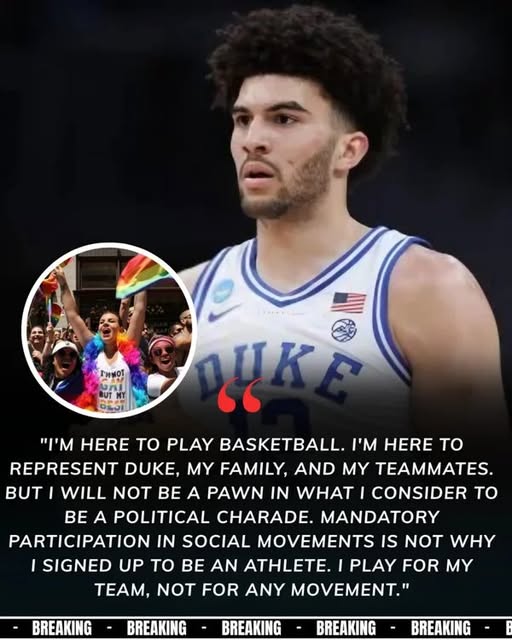
Duke player Cameron Boozer has sparked major controversy after refusing to wear an L.G.B.T armband ahead of the team’s upcoming game, calling it a “woke agenda.” Cameron explained:
Controversy has erupted around Cameron Boozer and the Duke Blue Devils men’s basketball after reports surfaced that the highly touted forward declined to wear an LGBTQ-themed armband ahead of the team’s upcoming game, describing the initiative as part of what he called a “woke agenda.” The situation has quickly drawn national attention, sparking debates that stretch far beyond the boundaries of college basketball and into broader cultural and social conversations taking place across sports.
According to sources close to the program, the armband was part of a league-wide or team-supported initiative aimed at promoting inclusivity and awareness. Such campaigns have become increasingly common across collegiate and professional sports, with athletes often encouraged to participate as a show of solidarity with marginalized communities. However, Boozer’s decision to opt out—and more importantly, his public explanation—has placed him at the center of a heated and polarizing discussion.
Boozer reportedly addressed the situation by emphasizing that his decision was rooted in personal beliefs rather than any intent to offend or disrespect others. He stated that he did not feel comfortable endorsing a message he believes has become politicized, reiterating that he respects all individuals but prefers to keep his focus on basketball and his own values. His use of the phrase “woke agenda” has drawn particular scrutiny, as critics argue that such language can be dismissive or inflammatory, especially in the context of initiatives designed to promote inclusion.
The reaction has been swift and divided. Supporters of Boozer have praised him for standing by his convictions, arguing that athletes should not be compelled to participate in symbolic gestures they do not personally agree with. They frame his decision as an example of individual freedom and authenticity, noting that true inclusivity should also allow room for differing perspectives. Some have also pointed out that athletes are often placed in difficult positions when social issues intersect with team or league expectations.
On the other side, critics have expressed disappointment and concern over Boozer’s stance, suggesting that refusing to participate in an inclusivity campaign sends a negative message, regardless of intent. For many, these initiatives are about visibility and support for communities that have historically faced discrimination, and opting out can be interpreted as a lack of solidarity. The language used in Boozer’s explanation has further fueled criticism, with some arguing that it undermines the purpose of such campaigns and contributes to broader cultural tensions.
The situation also places Jon Scheyer and the Duke program in a delicate position. As head coach, Scheyer must balance respect for his player’s individual beliefs with the expectations of the university, the team, and the wider community. Duke has long been viewed as a program that emphasizes not only excellence on the court but also character and leadership off it, making moments like this particularly challenging to navigate. While the program has not issued an extensive public statement, it is likely that internal conversations have taken place to address the matter and ensure that team unity remains intact.
This incident reflects a larger trend in sports, where athletes are increasingly finding themselves at the intersection of competition and social discourse. In recent years, players across various levels have used their platforms to advocate for causes they believe in, from racial justice to mental health awareness. At the same time, there has been growing debate over the extent to which athletes should be expected—or required—to participate in such initiatives, especially when they may conflict with personal beliefs.
For Boozer, the attention comes at a pivotal moment in his young career. As one of the most highly regarded prospects in college basketball, he is accustomed to being in the spotlight for his performance on the court. However, this situation introduces a different kind of visibility, one that extends into the realm of public opinion and media scrutiny. How he handles this moment, both in his words and actions moving forward, could shape perceptions of him beyond basketball.
It is also worth noting that locker room dynamics can be impacted by situations like this. Teams often strive to build a sense of unity and shared purpose, and differences in opinion on sensitive issues can test that cohesion. At the same time, many successful teams have demonstrated the ability to navigate diverse perspectives while maintaining a strong collective identity. The response of Boozer’s teammates—whether public or private—could play a significant role in determining how the situation evolves.
As the conversation continues, it underscores the complexity of balancing personal expression with collective initiatives in modern sports. Boozer’s decision, while personal, has become part of a much larger dialogue about identity, inclusion, and the role of athletes in societal conversations. There are no easy answers, and opinions are likely to remain divided.
Ultimately, this controversy serves as a reminder that college athletes today operate in an environment where their actions and words can carry significant weight. For Cameron Boozer, the focus will eventually return to basketball, but the discussions sparked by this moment may linger far longer, reflecting the evolving relationship between sports, culture, and individual belief systems.