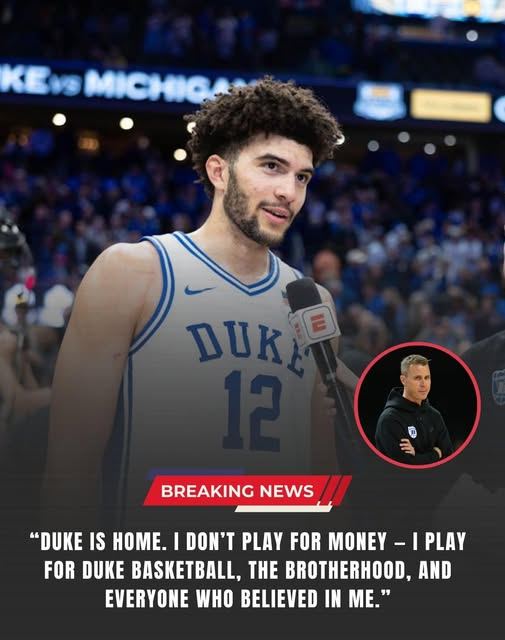
After hearing his name surface in transfer-portal buzz, Cameron Boozer made a stunning declaration — he said he’d be willing to turn down top NIL opportunities just to stay with the Duke Blue Devils basketball.
Cameron Boozer has sent a powerful message across the college basketball world, pushing back against swirling transfer portal speculation with a declaration that is quickly reshaping the conversation around his future. After hearing his name linked to potential movement and lucrative NIL opportunities, Boozer made it clear that his commitment to Duke Blue Devils men’s basketball goes far beyond financial incentives. In a landscape increasingly driven by money and mobility, his stance stands out as both rare and impactful.
The buzz surrounding Boozer began to build as whispers of potential transfer interest gained traction, fueled in part by the evolving nature of college athletics where players now have more freedom than ever before. With NIL opportunities continuing to expand, top-tier talents like Boozer are often at the center of attention, drawing interest not only for their on-court abilities but also for their marketability. For many athletes in his position, the temptation to explore those options can be significant, making his response all the more notable.
Rather than entertain the idea of leaving, Boozer leaned into his commitment, stating he would be willing to turn down top NIL offers just to remain at Duke. That declaration carries weight, not just because of who he is as a player, but because of what it represents. It signals a belief in the program, trust in the coaching staff, and a desire to build something meaningful rather than chase short-term gains. For a program like Duke, which has long been synonymous with tradition and excellence, that kind of loyalty reinforces the culture they aim to maintain.
Boozer’s decision also highlights a broader conversation about priorities in modern college basketball. While NIL has created life-changing opportunities for student-athletes, it has also introduced new dynamics that can influence decisions in ways that were not previously part of the equation. In choosing to prioritize fit, development, and continuity over financial gain, Boozer is offering a different perspective—one that emphasizes long-term growth and connection over immediate reward.
For Duke, his stance could have a ripple effect. When a player of Boozer’s caliber publicly commits to staying, it sends a message to teammates, recruits, and the wider basketball community. It reinforces stability within the program and can help attract like-minded players who value the same principles. In recruiting, perception matters, and moments like this can strengthen a program’s image as a place where players come not just to benefit individually, but to be part of something bigger.
There is also an element of leadership in Boozer’s words. Even without stepping on the court at the college level yet, he is setting a tone that could influence the locker room and shape team identity. Players often look to those with high profiles to gauge the direction of a program, and his willingness to stand firm sends a clear signal about the kind of environment he wants to be part of.
Of course, the reality of college basketball means that situations can evolve, and decisions are rarely final until they are tested over time. But for now, Boozer’s declaration cuts through the noise of speculation and provides clarity. It shifts the narrative from uncertainty to commitment, from possibility to intention.
In an era defined by movement and opportunity, Cameron Boozer’s stance is a reminder that loyalty and belief still hold value. Whether this moment becomes a defining chapter in his journey or simply one step along the way, it has already made an impression, shaping how both fans and observers view not only his future, but the evolving culture of the game itself.