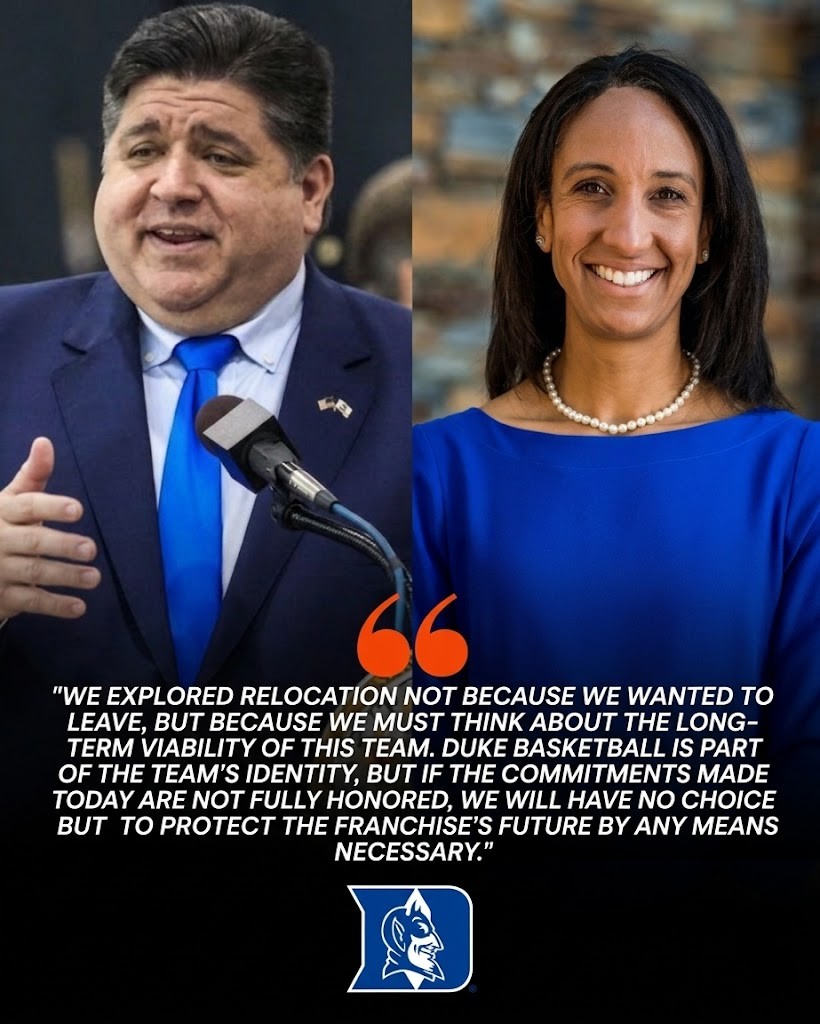
Just 12 hours after securing 25/32 NFL votes to relocate to Indiana, Governor J.B. Pritzker held an urgent “roundtable” meeting with Indiana Governor Mike Braun and Athletic Director Nina King — The deals announced afterward were exactly what Duke basketball fans had been hoping for.
Just 12 hours after securing the necessary NFL votes to approve a major relocation plan to Indiana, J. B. Pritzker moved quickly, convening an urgent and highly strategic roundtable that would soon ripple far beyond football. Sitting across from him was Mike Braun, alongside Nina King, a key figure representing the interests of Duke Blue Devils men’s basketball. What initially appeared to be a politically driven discussion tied to professional sports infrastructure soon revealed deeper implications for college athletics, particularly for one of the nation’s most storied basketball programs.
The timing of the meeting was no coincidence. With momentum building around the relocation decision, state leadership recognized an opportunity to leverage broader sports investments and partnerships. For Duke, the involvement of Nina King signaled that the program was not merely observing from a distance but actively engaged in shaping outcomes that could influence its competitive future. The conversations reportedly centered on facilities, scheduling alliances, and financial frameworks that could benefit both regional sports development and elite collegiate programs.
In the hours following the meeting, details began to emerge, and they aligned closely with what Duke basketball supporters had been hoping to hear. Among the most significant developments were discussions of enhanced neutral-site game opportunities in Indiana, a state synonymous with basketball tradition. Such arrangements would give Duke increased exposure in a basketball-rich environment while also strengthening recruiting pipelines in the Midwest. For a program that consistently competes for top talent, expanding its geographic footprint is a strategic advantage.
Equally important were the reported financial components tied to the agreements. With the evolving landscape of college athletics increasingly influenced by name, image, and likeness opportunities, any framework that bolsters revenue streams or creates new partnerships is viewed as a major win. The roundtable discussions are believed to have included pathways for collaborative events and sponsorship models that could directly or indirectly benefit Duke’s athletic programs. While specifics remain limited, the direction of the talks suggests a forward-thinking approach to sustaining competitiveness.
For Nina King, the meeting represented another example of proactive leadership in a rapidly changing environment. As athletic director, her role extends beyond managing existing programs to identifying opportunities that position Duke for long-term success. By engaging in high-level discussions alongside state governors, she demonstrated the program’s willingness to think beyond traditional boundaries and explore innovative solutions.
From a broader perspective, the intersection of professional sports decisions and college athletics underscores how interconnected the modern sports ecosystem has become. A relocation vote in the NFL can create ripple effects that influence everything from regional economies to collegiate scheduling strategies. Duke’s presence in these conversations highlights its status not just as a basketball powerhouse, but as a key stakeholder in the wider sports landscape.
For fans, the outcome of the meeting provided a sense of optimism. In an era where maintaining a competitive edge requires constant adaptation, the idea that Duke is actively pursuing new opportunities is reassuring. The reported deals suggest a program that is not content to rely solely on its history, but one that is actively shaping its future through strategic partnerships and bold initiatives.
As more details emerge, the full impact of the roundtable will become clearer. However, the immediate takeaway is that Duke has positioned itself at the center of a significant moment, one that could influence its trajectory in the coming years. For a program with championship aspirations, moves like these are not just beneficial—they are essential.