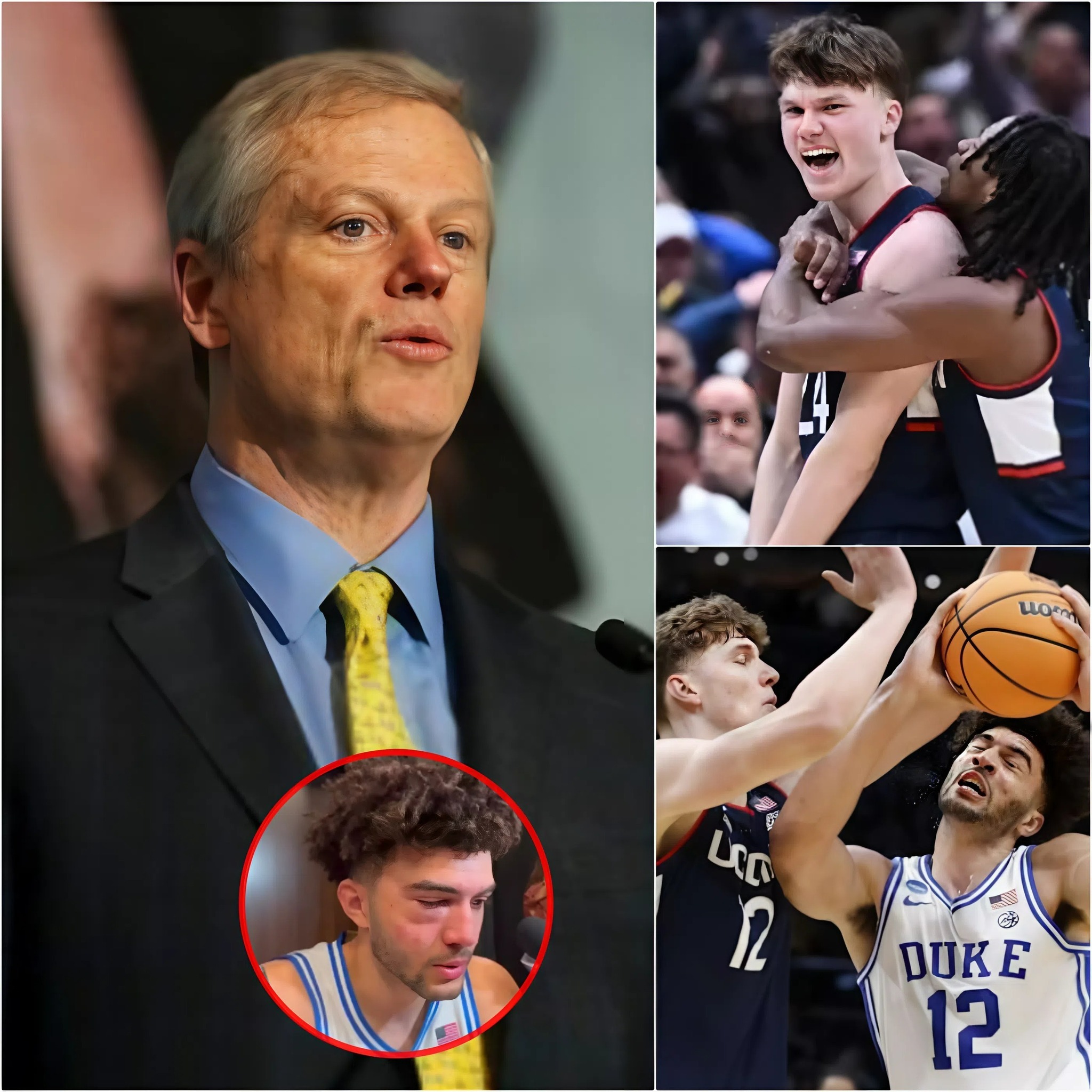
NCAA Commissioner unexpectedly issues the heaviest penalty in history for player Eric Reibe, star of the UConn Huskies. After reviewing the video footage from the game between the Duke Blue Devils and UConn Huskies, Charlie Baker stated that the incident between Eric Reibe and Cameron Boozer was not accidental, but rather a dirty play aimed at obstructing the referee’s view. This unacceptable conduct deserves punishment, and immediately, Eric Reibe spoke out, protesting his innocence and explaining
In a stunning and unprecedented decision, Charlie Baker has issued what is being described as the harshest penalty in NCAA history against Eric Reibe, the standout center for the UConn Huskies men’s basketball, following a controversial incident during a high-profile matchup against the Duke Blue Devils men’s basketball. The ruling came after an extensive review of game footage that allegedly showed Reibe engaging in what officials determined to be a deliberate act involving Cameron Boozer.
According to Baker’s statement, the sequence in question was not a routine physical play or an accidental collision, but rather a calculated move intended to obstruct the referee’s line of sight. The implication behind such a finding is significant, as it suggests not just unsportsmanlike conduct, but a premeditated attempt to manipulate the flow of the game. In a sport where integrity and fair play are paramount, the NCAA’s interpretation of the incident elevated it beyond a typical in-game violation into something far more serious.
The penalty itself, while not fully detailed in public statements, is believed to include a lengthy suspension and additional sanctions that could impact Reibe’s eligibility and standing within collegiate basketball. The severity of the punishment has sparked immediate debate across the basketball community, with analysts, former players, and fans weighing in on whether the NCAA’s decision reflects necessary accountability or an overreach that sets a troubling precedent.
Reibe, for his part, wasted little time in responding. In a statement released shortly after the ruling, he strongly denied any intentional wrongdoing, insisting that the play was misinterpreted. He explained that the moment occurred in the heat of competition, where positioning, movement, and physical contact happen rapidly and often without the level of control that slow-motion replays can suggest. Reibe emphasized that he has always played the game with respect for officials, opponents, and the rules, and that the idea of deliberately obstructing a referee is inconsistent with both his character and his understanding of the game.
He further noted that the interaction with Boozer was part of a natural sequence of play, involving attempts to establish position and react to the movement of both the ball and opposing players. From his perspective, any contact or positioning that may have affected the referee’s view was incidental rather than intentional. Reibe expressed frustration that the ruling did not adequately account for the context of live play, arguing that the decision was based too heavily on interpretation rather than clear evidence of intent.
The incident has also placed the spotlight on the broader issue of how intent is determined in sports officiating and disciplinary actions. Unlike clear-cut violations, cases involving alleged intent often rely on subjective analysis, which can lead to differing conclusions depending on perspective. In this case, the NCAA’s firm stance suggests a desire to send a strong message about maintaining the integrity of officiating, but it also raises questions about consistency and fairness in enforcement.
For the UConn program, the fallout could be significant. Losing a player of Reibe’s caliber, even temporarily, has the potential to disrupt team chemistry and performance, particularly in a season where expectations are high. At the same time, the situation presents a challenge for coaches and teammates, who must navigate the controversy while staying focused on their goals.
Meanwhile, the Duke-UConn rivalry gains another layer of intensity from the incident, as emotions surrounding the game extend beyond the final score. The involvement of Cameron Boozer adds further intrigue, given his prominence and the attention he commands as one of the sport’s rising stars.
As the story continues to unfold, the debate surrounding the NCAA’s decision is unlikely to subside. For Eric Reibe, the path forward will involve not only addressing the immediate consequences of the ruling but also working to restore his reputation in the eyes of the basketball community.