Deja vu as Duke suffers another epic collapse. Why does it keep happening?
WASHINGTON – A freshman superstar leads Duke to an ACC championship.
The Blue Devils surge through the finish line of the regular season and earn the top seed in the East Region.
They steer themselves toward the sixth national championship in program history and are poised to advance against a battle-tested opponent, building a double-digit lead and humming along, everything going exactly as planned.
This all may feel familiar.
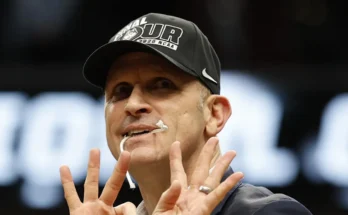
Last year, all this momentum and all of Duke’s postseason aspirations evaporated against Houston in the biggest meltdown in Final Four history. On Sunday, the Blue Devils were responsible for what may be the most epic collapses in the history of the Elite Eight, coughing up yet another double-digit lead in the second half and losing 73-72 to No. 2 Connecticut on guard Braylon Mullins’ 35-foot 3-pointer with 0.4 seconds left.
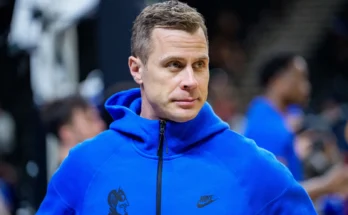
“I could not be more disappointed and feeling for our guys, at the same time of just trying to process what happened. I don’t have the words. I don’t have the words,” coach Jon Scheyer said. “I don’t have words other than just how proud I am of these guys and how disappointed we are.”
In last season’s national semifinal against the Cougars, Duke held a 14-point lead with 8:17 to play, were up by nine points with 2:15 remaining, were ahead by seven points with 1:26 to play and then by six points at the 42-second mark.
But Houston would outscore the Blue Devils 15-3 in the final two-plus minutes to win 70-67, delivering what Scheyer called at the time “the most heartbreaking loss.”
That loss has competition.
“What we’re feeling, we have every right to feel,” guard Isaiah Evans said. “We worked really hard for this goal. To fall so short in the way we did, you now, it hurts. So I’m saying, whatever you’re feeling, you’re entitled to feel that way.”
Thanks to a blitzkrieg-like 14-0 run, Duke led 44-25 with 3:24 to play and were on the verge of a delivering an early knockout blow against the smaller and seemingly outmanned Huskies. Despite a slight UConn run, the Blue Devils were up 44-29 at halftime.
That edge would grow to 17 points, at 50-33, after an alley-oop slam to Duke center Patrick Ngongba II three minutes into the second half. The Huskies would draw within seven points with 9:43 to play, but Duke would go up by 11 points with eight minutes remaining. Again, the Huskies would move within seven points with seven minutes left; on the next possession, a Nikolas Khamenia 3-pointer put Duke back in front by double digits.
Then came the collapse. Duke led 67-58 with five minutes to play after Evans made a pair of free throws. UConn would respond with a 7-0 run keyed by guard Solo Ball, who converted an and-one to make it 67-64 with 3:42 remaining.
After a Cameron Boozer turnover with 65 seconds left, UConn forward Alex Karaban nailed a 3-pointer to make it 70-69. Cameron Boozer responded with a short jumper. With 10 seconds left, UConn guard Silas Demary Jr. made one of two free throws to make it 72-70, setting up one of the most dramatic finishes in tournament history — and one of the lowest points in Duke history.
Taking the ball under the Huskies’ basket, Dame Sarr inbounded to Cameron Boozer, who was temporarily trapped by two UConn defenders. With 9.2 seconds to play, Cameron Boozer bounced a pass back to Sarr, who then passed ahead to point guard Cayden Boozer with 7.5 seconds left.
Second on the team in free-throw percentage entering Sunday at 79.7%, Cayden Boozer had made all six of his attempts from the line against the Huskies. But instead of tucking the ball and awaiting the inevitable foul from two UConn defenders, he tried to pass ahead to an open teammate.
“Cayden is one of our best free-throw shooters, so I just passed the ball,” Sarr said. “You know, whatever happened after that, you know, it feels like it kind of doesn’t matter. We’re a team and we fell together and we win together. Today we lost together. And that’s it.”
The pass was tipped by Demary and recovered on the Duke side of the halfcourt line by Mullins, who passed ahead to Karaban, received the ball right back and then let loose from around the -ess of the March Madness logo.
Swish. Ballgame.
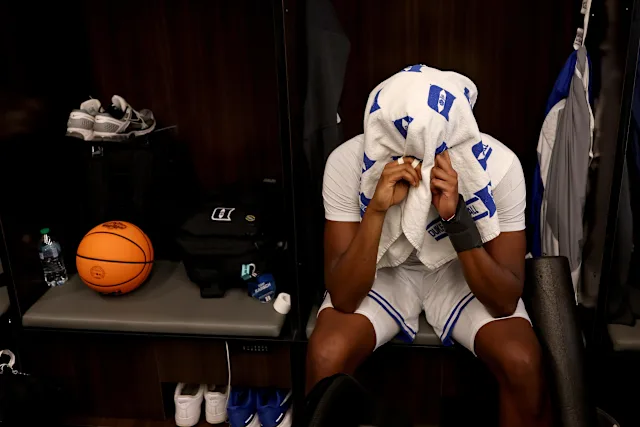
“I turned the ball over,” said Cayden Boozer. “I ruined our team’s season. That’s the best I can put it.”
You can point to a number of factors behind the meltdown. The Huskies got into the bonus with six minutes to play, slowing down the pace of the game and disrupting Duke’s flow. The Blue Devils didn’t put their foot down in the early stages of the second half. They rushed their possessions.
One year after an unforgettable failure, the Blue Devils failed to digest that painful lesson and repeated the same crucial, game-changing mistakes.
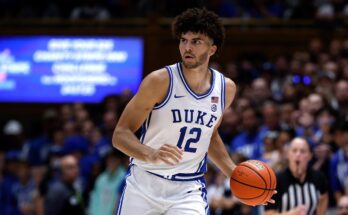
“I think we fought hard,” said freshman forward Cameron Boozer, who closed out a brilliant season with a game-high 27 points to go with eight rebounds and four assists.
“We gave a lot, but I think as a whole we could have gave a lot more in the second half. We came out a little flat and gave them a little bit of life. When you’re playing a team as good as UConn, that’s all they really need.”
This is obvious: Duke is a superstar program, with superstar players and a superstar coach. But there is clearly something wrong with the Blue Devils.
The culprit for back-to-back tournament debacles is the program’s approach to roster management compared to the majority of teams in annual competition for the national championship. While others lean heavily on transfers, Scheyer and Duke continue to rely on traditional high-school recruiting to nab one-and-done centerpieces such as Cameron Boozer and Cooper Flagg.
“I found, for me, this is all I’ve ever known, coaching freshmen and young players,” Scheyer said Saturday.
Dominant freshmen have helped the Blue Devils lose just a combined seven games the past two seasons. But every one of these losses can in some way be attributed to youthful inexperience: Duke had a double-digit lead in all three losses this season, while each of last year’s losses — by single digits to Kentucky, Kansas, Clemson and Houston — occurred after late turnovers by Flagg and fellow freshman Kon Knueppel.
And in each season, Duke rode a freshman-driven roster deep into the tournament before being wobbled by veteran-driven steadiness. No, UConn doesn’t have the Blue Devils’ star power; the Huskies have been here before, though, and that was the difference.